


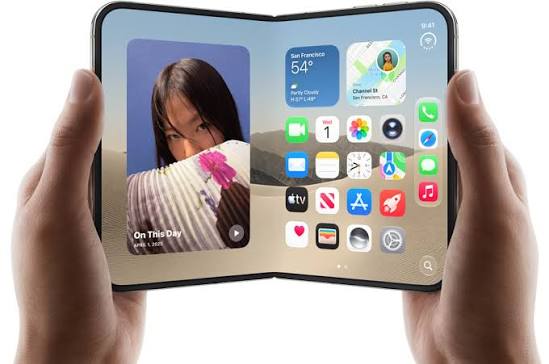
Apple has unveiled its first foldable iPhone, the iPhone Duo, with a starting price of $1,999, placing the company’s new chief executive, John Ternus, behind one of its biggest product bets in years.
The launch represents Apple’s first major change to the iPhone’s design in almost two decades and brings the company into a foldable smartphone market already dominated by established competitors including Samsung and Huawei.
The iPhone Duo was unveiled during Apple’s launch event in Cupertino, California, on Wednesday. Prices in the United States start at $1,999 and can rise to about $3,200 depending on the configuration.
The device has reportedly taken about eight years to develop, with Ternus having been directly involved in the project during his years as a senior executive within Apple’s hardware division.
The launch also comes at a significant moment for Apple, as Ternus took over as the company’s chief executive from long-time CEO Tim Cook earlier this month.
The timing has led analysts to view the foldable iPhone as an important early test for Ternus as he begins his tenure at the top of the technology giant.
Apple’s new device is designed to offer a larger display when unfolded while retaining a more conventional smartphone form when closed. When opened, it resembles a small iPad, while its folded form is wider than a traditional iPhone.
Ternus described the device as combining a completely new design with a familiar user experience. He also highlighted its size, saying it is similar to a passport and designed to be comfortable to hold and use with one hand.
The Apple chief executive used the launch to distinguish the company’s approach from existing foldable smartphones.
He argued that some competing devices can feel like two phones attached together, while Apple’s design was intended to provide a more integrated experience.
However, Apple is entering the market at a time when foldable smartphones remain a relatively small part of global smartphone sales.
According to Ben Wood, chief analyst at technology research firm CCS Insight, foldable smartphones currently account for only about 2 per cent of smartphone sales.
Even with Apple’s entry expected to stimulate interest in the category, Wood said foldables could account for only around 4 per cent of the total smartphone market over the next decade.
Apple therefore faces the challenge of persuading consumers to pay a significant premium for a device belonging to a category that remains relatively niche.
The company is also entering a market where competitors have already built substantial experience.
Francisco Jeronimo, vice president for data and analytics, devices at IDC EMEA, pointed specifically to China, where Huawei has established a strong position in the foldable smartphone market.
The competitive environment could make Apple’s pricing strategy particularly important as it attempts to convince consumers that its first foldable device offers enough advantages to justify the premium.
At $1,999, the iPhone Duo is significantly more expensive than Apple’s conventional smartphones. The previous highest starting price for a new iPhone was $900, according to the report.
Apple also unveiled the iPhone 18 Pro and iPhone 18 Pro Max, with starting prices of $1,199 and $1,299 respectively in the United States.
Analysts have questioned whether the foldable iPhone will become a major source of growth for Apple or remain a premium product purchased primarily for its novelty and status.
Dipanjan Chatterjee, an analyst at Forrester, said the device could become a high-priced product that adds prestige to Apple’s portfolio without generating significant growth.
He also compared its prospects with Apple’s Vision Pro headset, which launched at $3,699 and has struggled to achieve broad consumer adoption.
On the other hand, Chatterjee said the foldable iPhone could follow the trajectory of the Apple Watch, which has not achieved the same level of popularity as the iPhone but is still purchased by millions of consumers each year.
Another challenge is the familiarity consumers have developed with the traditional iPhone experience.
Carolina Milanesi, an analyst at Creative Strategies who attended Apple’s presentation, said consumers may be interested in foldable devices but warned that moving from a conventional smartphone to a foldable device involves a learning curve, particularly around software.
That challenge could determine whether Apple’s approach succeeds in attracting mainstream buyers rather than only technology enthusiasts.
The stakes are particularly high because the iPhone remains Apple’s most important product, accounting for more than half of the company’s annual sales.
Apple has recently reported strong demand for its iPhones, including describing its latest version as its most successful product launch.
The foldable device therefore represents a significant departure from the established iPhone formula at a time when the company continues to rely heavily on the smartphone for revenue.
Alongside the hardware announcements, Apple also provided further details about its plans for Siri AI, a major upgrade to its digital assistant.
Beginning with the iPhone 18, Siri AI will be able to search across information stored on a user’s device, including messages and emails, to find information, answer questions and take actions on the user’s behalf.
Some of the new Siri AI capabilities will also be available on the Apple Watch. These include the ability to take notes from conversations and transcribe them when users enable the feature.
Ternus described the new AI capabilities on the iPhone as an “intelligent personal hub”, while acknowledging that the system would have access to highly private information from users’ daily lives.
Privacy was a major part of Apple’s presentation of its AI strategy.
Ternus said many of the AI functions would operate directly on the device rather than through third-party companies. Where cloud-based processing is required, he said Apple would maintain privacy through its remote server infrastructure.
The company is seeking to differentiate its AI approach by emphasising that users’ personal information will remain protected and inaccessible to Apple itself under its privacy architecture.
The combination of the foldable iPhone and expanded AI capabilities gives Apple two significant areas of focus as it begins a new phase under Ternus.
The iPhone Duo represents a major physical redesign of Apple’s flagship product, while Siri AI signals the company’s push to make artificial intelligence a more deeply integrated part of the iPhone experience.
Whether the foldable iPhone becomes Apple’s next major product success or a premium niche device will depend on consumer demand, pricing, software integration and the company’s ability to differentiate itself from competitors that have been selling foldable phones for years.
For now, Apple has made its move into the foldable market, placing a $1,999 starting price and a radically different form factor at the centre of its latest iPhone strategy.