


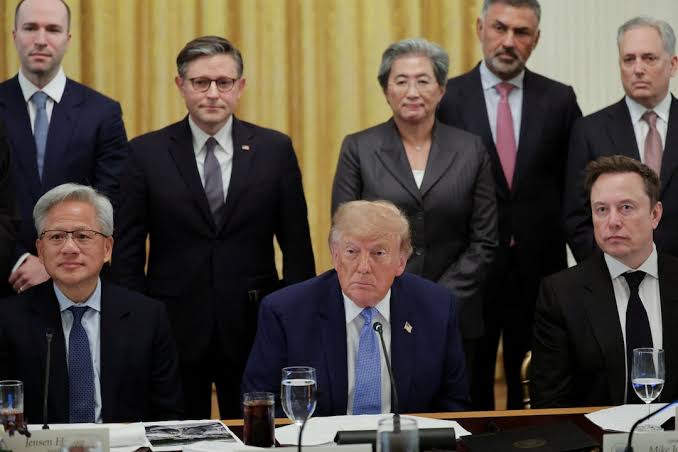
US President Donald Trump has said his administration is considering the creation of an oversight committee for artificial intelligence after he and leading technology executives signed what he described as a “morally binding” document on AI.
Trump disclosed the development on Tuesday, September 29, following a meeting with technology executives in Washington, where discussions focused on the rapidly advancing technology and the risks associated with increasingly capable AI systems.
Describing the document as a form of protection, Trump compared it to a constitution and said some of the world’s leading technology figures had signed it alongside him.
“It’s almost like a Constitution in a way, and the biggest people in the world signed that and I signed it as president and it really is a form of protection,” Trump told reporters after the meeting.
Trump described the document as “morally binding,” although the information available does not indicate that it creates legally enforceable obligations for the companies or executives involved.
Possible 10-Member Oversight Committee
Trump also revealed that his administration was considering establishing a committee to monitor developments across the AI sector.
According to the president, the proposed committee could consist of about 10 people who would be tasked with watching over the broader AI enterprise.
“We’re also thinking about forming a committee of sorts where we put maybe 10 people on that committee … so the committee can watch over the whole enterprise,” Trump said.
Details about the proposed committee, including its membership, powers, structure and whether it would have any regulatory authority, have not been provided.
The proposal comes as governments around the world continue to examine how best to respond to rapid advances in artificial intelligence.
AI systems are being developed and deployed across a growing range of sectors, while technology companies and researchers have raised concerns about the potential consequences of increasingly powerful systems.
The pace of development has also created challenges for governments attempting to keep existing policy and regulatory frameworks aligned with technological advances.
US Debate Over AI Regulation
The latest development comes amid an ongoing debate in the United States over the appropriate role of government in regulating artificial intelligence.
Leading AI companies have warned about potential risks associated with increasingly powerful systems and have called for cooperation between governments and industry to address those concerns.
Trump has previously argued that the United States does not need new AI-specific regulations.
During the United Nations General Assembly the previous week, Trump said he rejected what he described as an attempt to establish a global framework for controlling AI.
His comments about a possible oversight committee therefore come against a broader debate over how the US should balance technological development, industry activity and government supervision.
The proposed committee, if established, could provide a mechanism for monitoring developments in the sector. However, it remains unclear whether such a body would focus primarily on voluntary industry commitments, safety issues, regulatory compliance or broader questions surrounding AI development.
Growing Focus On AI Governance
The document signed by Trump and technology executives reflects the increasing attention being given to AI governance as the technology becomes more capable and widespread.
The technology industry has become an increasingly important participant in discussions with governments over AI safety, cybersecurity and the potential social and economic consequences of advanced AI.
At the same time, governments have adopted different approaches to regulation, with policymakers weighing the potential benefits of technological development against concerns about safety, accountability and misuse.
The United States remains a major centre for AI research, development and investment, making policy decisions around the technology significant for both American companies and the wider global technology industry.
Trump’s description of the agreement as “morally binding” suggests a focus on voluntary commitments rather than the creation of a new statutory regulatory framework, based on the details contained in the report.
The possible oversight committee could represent an additional layer of supervision if the administration decides to proceed with the proposal.
However, no details have yet been provided about who would serve on the committee, how members would be selected or what authority they would have.
The agreement also comes as AI developers compete to build increasingly capable systems, intensifying discussions about how governments can address potential risks while allowing technological development to continue.
For policymakers, the challenge extends across several areas, including cybersecurity, privacy, economic disruption, safety and the responsible deployment of AI systems.
The technology is already being applied across sectors such as healthcare, finance, education, manufacturing and government services, increasing the importance of decisions about how its development and use should be monitored.
Trump’s latest comments add another element to the evolving US discussion over AI governance. While he has previously opposed what he considers excessive regulation, his suggestion of an oversight committee indicates that his administration is considering a mechanism for monitoring the sector.
The proposed arrangement remains at the discussion stage, and the available information does not establish whether the committee will ultimately be created or what specific responsibilities it would have.
For now, the signed document and Trump’s comments point to continued engagement between the US government and the technology industry as policymakers confront the opportunities and risks associated with rapidly advancing artificial intelligence.