


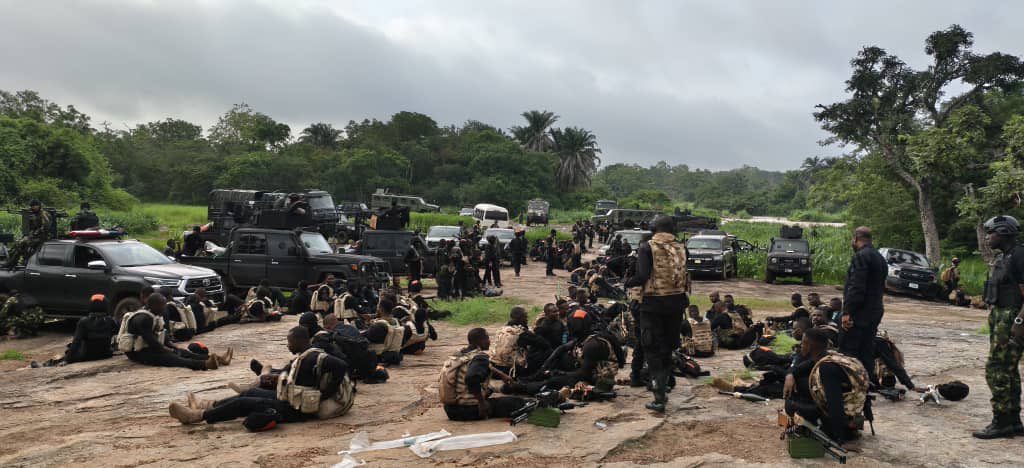
The General Officer Commanding (GOC) 2 Division of the Nigerian Army, Major General Chinedu Nnebeife, has revealed that thick forest vegetation in the Old Oyo National Park prevented Nigerian Air Force aircraft and surveillance drones from locating the terrorists who abducted 44 pupils and teachers in Oyo State, forcing security forces to launch a high-risk ground operation.
Speaking during a press briefing on Monday, Nnebeife explained that the dense forest canopy made aerial surveillance ineffective throughout the operation, which lasted more than a month before the victims were rescued after spending 56 days in captivity.
According to him, both the Air Force and drone teams were deployed to support the search but were unable to detect the kidnappers because the thick vegetation completely obscured visibility from above.
He noted that the inability to gather useful intelligence from the air compelled the military to rely on troops on the ground, a decision that came at a heavy cost.
Nnebeife disclosed that one Army officer and one soldier were killed during one of the ground assaults, while several others sustained injuries, including a soldier who suffered a severe gunshot wound that left him with a broken arm.
Following the setback, the GOC said he assumed direct command of the operation from the garrison commander, coordinating troops and intelligence assets drawn from different parts of the country.
He explained that the operation involved personnel from the Office of the National Security Adviser (ONSA), the National Counter Terrorism Centre (NCTC), Defence Headquarters Special Forces, the Nigerian Army, Navy, Air Force, Nigeria Police Force, Department of State Services (DSS), Nigeria Security and Civil Defence Corps (NSCDC), National Intelligence Agency (NIA), local vigilantes and hunters.
The Nigerian Air Force also deployed a Tactical Operations Group from Kainji with fighter aircraft, while troops from Operation Savannah Shield established blocking positions along the northern axis of Oyo State to restrict the movement of the terrorists.
Nnebeife disclosed that an earlier attempt involving hunters and local vigilantes shortly after the abduction was unsuccessful, with some of the local volunteers losing their lives during the wider operation.
He said the breakthrough eventually came on July 10 after security forces successfully blocked the kidnappers’ primary logistics corridor through Ashamu, cutting off their supplies and exerting intense pressure on the group.
According to the Army commander, the sustained military pressure forced the terrorists to offer the unconditional release of the 44 abducted pupils and teachers.
He stressed that the military refused to negotiate with the kidnappers despite their reported demand for the release of a detained Boko Haram commander and the deaths of two teachers while in captivity.
“I have always said we will never yield to terrorists’ demands. We will not, and we never will,” he stated.
The successful rescue was earlier confirmed by the Special Adviser to the President on Information and Strategy, Bayo Onanuga, who announced that eight suspected kidnappers had been arrested and handed over to the Department of State Services, while several other members of the criminal gang were neutralised during the operation.
The Army also confirmed that Lieutenant Felix Isaac, a 28-year-old officer who led troops during the rescue mission, was killed in action on July 10. He was buried with full military honours at the 23rd Armoured Brigade Cemetery in Yola, Adamawa State, on the same day the rescued pupils and teachers were reunited with government officials.