


Nigerian scientist Mary Brenda Akoda has emerged winner of the 2026 Nigeria Prize for Science and Innovation (NPSI), securing the $100,000 award for GenScan AI, an artificial intelligence technology designed to significantly reduce the time required for MRI scans.
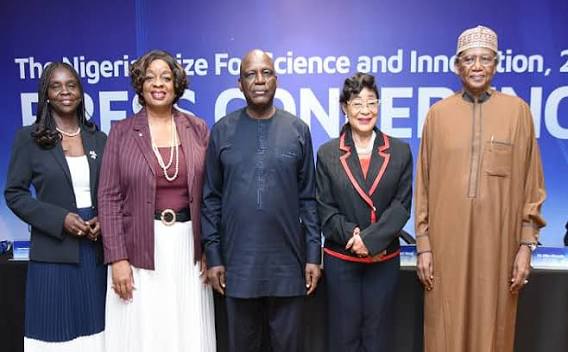
Akoda was announced as the winner at a press conference in Lagos on Tuesday after her entry was selected by a panel of judges chaired by Dr Omobola Johnson, former Minister of Communications.
Her winning innovation, GenScan AI, addresses one of the challenges associated with magnetic resonance imaging by using artificial intelligence to accelerate the reconstruction of MRI images.
The technology emerged as the top entry from 237 submissions, the highest number of applications recorded by the Nigeria Prize for Science and Innovation since its establishment.
Akoda’s achievement also marks two firsts for the prize. She is the first millennial and the first woman to win the Nigeria Prize for Science and Innovation as an individual.
The competition, backed by Nigeria LNG Limited (NLNG), did not produce a winner in 2025.
Announcing the 2026 winner, Dr Sophia Horsfall, General Manager, External Relations and Sustainable Development at NLNG, said the outcome demonstrated that the competition continued to maintain rigorous standards.
Horsfall said entries were subjected to a thorough evaluation process before a winner could emerge, stressing the importance of credibility in determining the recipient of the award.
Professor Barth Nnaji, Chairman of the NPSI Advisory Board, said the judges reached a unanimous decision in favour of Akoda’s innovation.
According to Nnaji, GenScan AI stood out because of its combination of technical innovation and practical relevance to healthcare.
The technology, also known as GenMRI or C-MORE, uses a one-step consistency model to reconstruct MRI images more rapidly. One of its notable features is that it does not require new hardware to operate.
The innovation has the potential to reduce MRI scan times by as much as 90 per cent, according to information presented during the evaluation of the technology.
A significant reduction in scanning time could have implications for healthcare facilities that rely on MRI machines, particularly in environments where access to advanced medical equipment is limited.
Judges said the technology could improve the efficiency of MRI scanners while reducing the amount of time patients spend waiting for scans. It could also potentially contribute to expanding access to MRI services in resource-constrained healthcare systems.
MRI scans are used in the diagnosis and monitoring of a wide range of medical conditions, but the time required to complete scans can place pressure on available equipment and create delays for patients.
By reducing the time required to reconstruct MRI images without demanding new hardware, GenScan AI seeks to address the challenge through software and artificial intelligence.
The technology therefore represents an example of how AI can be applied to existing healthcare infrastructure rather than requiring institutions to completely replace their equipment.
Akoda’s academic and professional background also reflects a strong focus on computer science and artificial intelligence.
She holds a First-Class degree in Computer Science from Goldsmiths, University of London, as well as a Master of Research with Distinction in AI and Machine Learning from Imperial College London.
During her studies at Imperial College London, Akoda was a Google DeepMind Scholar, further reflecting her background in artificial intelligence research.
Her professional experience includes working as a software engineer and AI research scientist at Microsoft. She worked with the company’s Mixed Reality and AI Research Lab in Cambridge.
The combination of her academic training and experience in software engineering and AI research contributed to the development of the technology that ultimately secured the 2026 Nigeria Prize for Science and Innovation.
The recognition comes as artificial intelligence continues to expand into sectors beyond traditional computing, including healthcare, where researchers and technology companies are exploring ways to use AI to improve diagnosis, treatment and access to medical services.
For Nigeria, the award also highlights the potential of locally developed technologies to address challenges within the country’s healthcare system.
The judges’ emphasis on GenScan AI’s practical relevance suggests that the technology’s potential impact on healthcare was a key consideration in selecting Akoda’s entry from the record number of submissions.
The ability to reduce MRI scan times without requiring new hardware could be particularly relevant to healthcare facilities operating under infrastructure and resource constraints.
However, the technology’s broader impact will depend on its continued development and adoption within healthcare environments, as well as its ability to operate effectively alongside existing MRI systems.
Akoda will formally receive the $100,000 prize at the Grand Award Night scheduled for October 9, 2026.
Her win adds a significant milestone to the Nigeria Prize for Science and Innovation and places an AI-powered healthcare innovation at the centre of the 2026 competition.
With GenScan AI offering a potential reduction of up to 90 per cent in MRI scan times, the judges said the technology could improve scanner efficiency, reduce patient waiting periods and support wider access to MRI services.
Akoda’s achievement also demonstrates the growing role of artificial intelligence in solving practical problems and developing technologies with potential applications in critical sectors such as healthcare.
The 2026 Nigeria Prize for Science and Innovation has consequently recognised not only an individual scientist but an innovation aimed at applying AI to a specific healthcare challenge, with the potential to improve how MRI services are delivered in resource-constrained settings.