


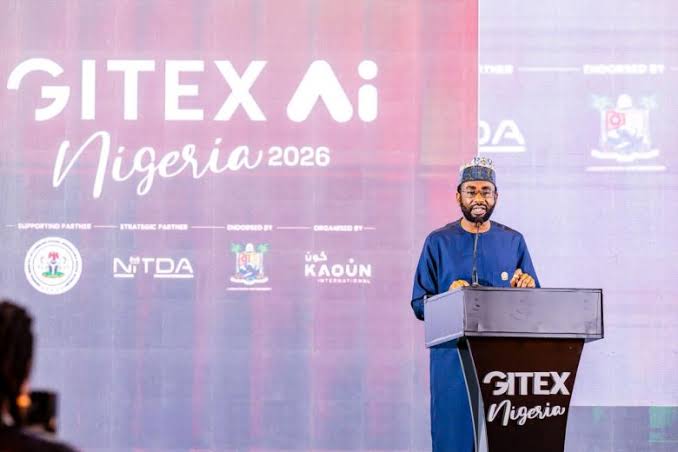
NITDA DG Calls for AI Sovereignty at GITEX Nigeria
The Director General of the National Information Technology Development Agency (NITDA), Kashifu Inuwa Abdullahi, has called on Nigeria to prioritise artificial intelligence sovereignty as the country seeks to strengthen its digital economy and protect national interests.
Inuwa made the call at the opening of GITEX Nigeria 2026 in Abuja, where he said Nigeria’s approach to AI sovereignty must go beyond geopolitical considerations to include the country’s ability to exercise control over the technologies, infrastructure and data that underpin artificial intelligence systems.
According to the NITDA Director General, Nigeria’s ability to determine how AI technologies are developed, deployed and governed will be increasingly important to the country’s economic development, citizen protection and national security.
He argued that AI sovereignty should involve greater digital self-determination across the entire technology stack.
AI Sovereignty Goes Beyond AI Models
Inuwa stressed that building national AI capacity requires more than developing artificial intelligence models.
He identified connectivity, data centres and cloud infrastructure as critical components of the country’s AI ecosystem, noting that these systems provide the foundation on which AI technologies operate.
The NITDA chief said Nigeria must therefore pay attention to the infrastructure supporting AI alongside the development of applications and models.
He pointed to the recent signing of regulatory instruments covering cloud and data sovereignty as important steps towards strengthening the country’s digital infrastructure.
According to him, the regulatory measures could encourage greater investment in data centres while helping Nigeria establish stronger control over the infrastructure used to store and process critical data.
The emphasis on local infrastructure reflects the growing importance of data and computing capacity in the development and deployment of modern AI systems.
Inuwa Wants Greater Nigerian Ownership
The NITDA DG also called for greater Nigerian ownership of AI technologies, algorithms and data.
He argued that strong data sovereignty and effective governance would be necessary if Nigeria is to develop AI systems that properly address the country’s specific needs.
For Inuwa, ownership and control of data are particularly important because AI systems depend heavily on the quality, availability and relevance of the data used to develop and operate them.
Greater local participation in the AI value chain could also help Nigeria develop technologies that are better suited to its population, economy and social environment.
The call comes as Nigeria continues to expand its digital economy and explores the use of AI across different sectors.
Who Controls Critical AI Systems?
Another aspect of Inuwa’s argument focused on operational sovereignty.
He said Nigeria must consider who controls AI systems deployed in critical sectors and whether those systems operate within Nigerian laws and regulatory frameworks.
He specifically highlighted sectors such as finance, healthcare and education, where AI systems could increasingly influence important decisions and public services.
According to Inuwa, a lack of control over critical AI infrastructure and systems could create vulnerabilities and expose the country to manipulation or external influence.
The issue is particularly relevant as governments and businesses increasingly rely on foreign technology platforms, cloud infrastructure and AI services.
Building local capacity, he suggested, would give Nigeria greater ability to determine how critical technologies are used and governed.
Nigeria First Policy And Digital Infrastructure
Inuwa said NITDA’s work under President Bola Ahmed Tinubu’s Nigeria First Policy is focused on strengthening digital, data, cloud and AI sovereignty.
The policy direction, according to the agency, is intended to increase local participation and capacity across important areas of the digital economy.
For Nigeria’s AI ecosystem, this could involve strengthening domestic infrastructure, supporting local technology developers and improving the country’s ability to manage its own data and digital systems.
The NITDA DG said the country must approach AI development as a broader national capacity-building exercise rather than focusing exclusively on individual AI applications.
GITEX Nigeria 2026
The comments were made as technology stakeholders gathered for GITEX Nigeria 2026, providing a platform for discussions around the country’s digital transformation and emerging technologies.
Inuwa described the event as an opportunity for Nigeria and other African countries to examine their progress in developing indigenous AI capabilities.
He said the continent must consider how it can strengthen its technological sovereignty as artificial intelligence becomes increasingly important to economic competitiveness and national development.
The discussion around AI sovereignty also highlights the growing relationship between artificial intelligence and other areas of digital infrastructure.
From cloud computing and data centres to connectivity and data governance, the systems required to support AI increasingly form part of a wider digital ecosystem that countries must develop and secure.
For Nigeria, building stronger capabilities across these areas could determine how much value the country is able to capture from the global AI economy.
Inuwa’s call therefore places local ownership, infrastructure, governance and operational control at the centre of Nigeria’s AI ambitions as the country seeks to develop a more resilient and self-reliant digital economy.