


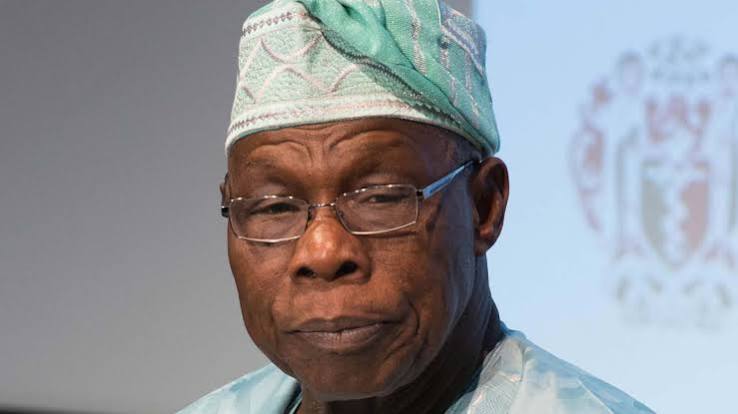
Former President Olusegun Obasanjo has warned that many of the factors that led to Nigeria’s Civil War remain unresolved, stressing that the country must never be allowed to descend into another armed conflict.
Obasanjo made the remarks in Abeokuta, Ogun State, during the presentation of Asaba Massacre, a historical account of the Nigerian Civil War authored by the Isama Aje of Asaba, Chief Chuck Nduka-Eze, at the Olusegun Obasanjo Presidential Library.
The former president said Nigeria had already paid too great a price during the 1967–1970 civil war and could not survive another similar conflict.
“Some of the things that led to the civil war are still on. How long will this be with us?” Obasanjo asked.
Recalling a conversation with former Head of State, General Yakubu Gowon, Obasanjo said both men shared the conviction that Nigeria must never experience another civil war.
“I was with a colleague when General Yakubu Gowon said, ‘We will not survive a second civil war as a country,’ and I believe we have fought one civil war too many already.
“So, to say that we will have a second civil war, God forbid. We must learn from what happened, condemn those actions that should never have occurred, and do everything humanly possible to prevent a recurrence.”
He urged Nigerians to embrace the principle of “Never Again” by preserving the lessons of history and addressing the underlying issues that continue to threaten national unity.
Obasanjo described the documentation of the Asaba Massacre as an important contribution to preserving Nigeria’s history, noting that understanding the past is essential to building a better future.
“We preserve the past, capture the present and inspire the future. This is part of preserving the past so that people can learn from it,” he said.
The former president, who served as a military commander during the civil war, admitted that he could not speak authoritatively about the Asaba Massacre because the area was under the command of the late General Murtala Muhammed at the time.
“I must confess that when people talk about the Asaba Massacre, I cannot give details of it,” he said, adding that he intends to study the transcript and audiovisual materials accompanying the historical work.
Obasanjo, however, recalled personally intervening during the war to prevent the rape of a woman by a soldier, describing such actions as unacceptable.
Presenting the publication, Chief Chuck Nduka-Eze said the work was based on extensive research, including eyewitness accounts, recorded interviews, archival materials, audiovisual evidence and established historical scholarship.
According to him, the evidence revealed a consistent pattern of events following the entry of federal troops into Asaba during the civil war.
He explained that civilians were assembled in public places and instructed to declare their loyalty to Nigeria by proclaiming “One Nigeria” before men were separated from women and children.
Nduka-Eze said multiple independent accounts indicated that many of the unarmed men were subsequently killed despite publicly affirming their allegiance to the Nigerian state.
While noting that the exact casualty figure remains uncertain, he said available evidence points to the deaths of more than 1,000 civilians and describes the incident as a devastating tragedy in the history of the Asaba community.
Like Obasanjo, Nduka-Eze warned that many of the divisions that contributed to the civil war still exist today, arguing that suspicion among Nigeria’s ethnic groups remains a challenge to national cohesion.
He urged Nigerians to confront the lessons of history and promote reconciliation to ensure that such a tragedy never happens again.